The Wall of Infinite Diversity

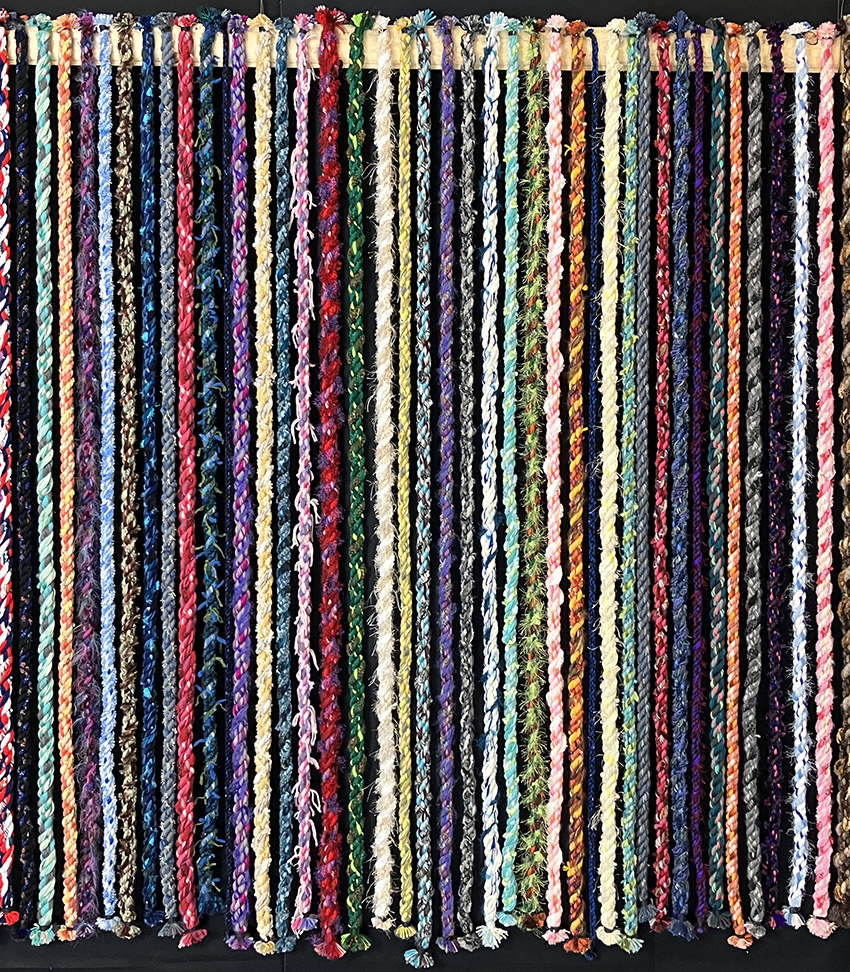
The Wall; 2022 version with approximately 770 six foot long ropes and cords sorted by color.

The Wall; 2024 version with approximately 1,400 unsorted ropes and cords.
I want to make something big enough to confront problems like climate change, racism, or fascism. Feeling overwhelmed, I have withdrawn and have been making work that is small, intimate, and personal. When I started spinning ropes, I did not have this project in mind. It had been a hard few years and I needed to process grief by making something more physical, tactile, and intuitively aesthetic than the kind of intellectual and conceptual work I normally make. I had been saving up yarn from yard sales and thrift stores for just such a project and in 2020 I built a small rope making machine. As I spun the yarns into ropes there was something about the process that I found very engaging and when finished each rope felt like some new and interesting character. I had no use for ropes and cords but they seemed beautiful and valuable for their own sake, and collectively they felt like they could be something bigger.
Each rope I make ends up about 30 feet long. From that I set aside a foot long piece for a sort of catalog, or journal of rope samples, and a six foot piece for what I had been referring to as the large curtain. For the first two years I also set aside a four foot piece from each rope and in 2022 I took hundreds of them and mounted them on a series of fourteen stretched canvas panels. (See here.) When I displayed the panels at my local library I was pleasantly surprised how people of all ages would reach out and touch them, often pointing out to each other which were their favorites. There is something very accessible about fiber art.
I live in a conservative city where too many people embrace the language of racism and exclusion. Instead of naming their favorites, I'm tempted to ask the rhetorical question, "Which do you hate?" or "Which ropes should be excluded?" There are plenty that seem insufficiently beautiful in comparision to others. Some appear dingy, unwashed or are a bit too ragged with too many knots and loose ends. Maybe I should exclude those that are red, white and green, the colors of the Mexican flag. But red, white and green are also colors of Christmas. It might be tempting to make a wall, or hall, or curtain out of only my personal favorites, or only the best and most beautiful ropes, but there is something especially impactful when seeing them all together, complementing and contrasting each other.
I'm still thinking about the best way to present them. In 2022 I sorted them like a spectrum. (I don't have a place big enough to photograph them all so the above pictures were taken in six and a half foot sections, combined in Photoshop.) The spectrum made an interesting picture but the character of individual ropes gets lost, even when up close. The next picture has even more ropes, and this time they are mixed up. In both above pictures, the ropes are placed close together, about 14 ropes and cords per foot. But for the individual character of each rope to really stand out there needs to be about an inch between each one. Packed tight the full set will cover about 100 feet of wall. Spaced about seven or eight ropes per foot they can cover 180 feet of wall or more. I've also photographed them against both black and white backgrounds to compare the effects. (I prefer black, but most galleries are white.)


I am currently looking for somewhere to install the piece. As a freestanding wall I would set it up as a double layer roughly 50 feet long. As a hall, the room could be anywhere from 25' x 30' up to twice that with ropes blanketing the walls. Naturally a larger room allows for more space between each rope. What I would really like to create is a hanging forest of ropes. I would like to have a thousand ropes dropped down from the ceiling spaced about a foot or two apart, so that visitors couldn't help but brush up against them as they pass through the space. A forest of infinite diversity. Another idea is a labyrinth. Ropes could form corridors, punctuated at key points with the larger pole mounted sets from page two. The maze could culminate in a forest, or simply a large wall with sets of ropes rising from floor to ceiling like the ribs of columns, shafts of bamboo, or a grove of tall trees.